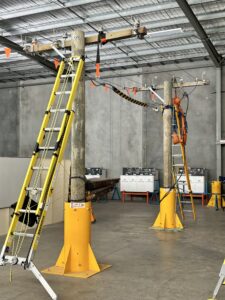


We offer a range of Courses that are mapped to Units of Competency covering the skills and knowledge required for safe entry to confined spaces under a work permit, maintaining safety while working in the confined space and undertaking confined space rescue.
This course will allow learners to enhance their skills and knowledge required for safe entry to confined spaces under a work permit, maintaining safety while working in the confined space and undertaking confined space rescue.
- Duration
- 1 day
- Delivery
- Trainer led classroom theory and practicals
- Location
- This training can be delivered:
• At a customers specific site
• At one of Thomson Bridge's approved training facilities - Cost
- Contact our Office for details on 1300 15 66 85 or email us on admin.au@relyon.com.
Who should attend
The target learners for this instance of course delivery are employees who are required to work in confined spaces. This includes employees of network asset owners, contractors and sub-contractors in electricity Generation, Transmission and Distribution. Those who work on the network must maintain currency of skills and competency in a range of safety and technical competencies.
Relevant safety related training programs are often mandated by regulation or industry agreements and documented in state codes of practice. Most learners will be licensed and trade qualified or hold a Certificate in a related technical discipline. In addition to trade qualifications, the learner groups will have completed a range of electrical and plant safety related training programs related to the roles they hold.
Due to the significant safety risks in the industry these employees work within highly proceduralised workplaces with mature workplace safety systems. Workers in the industry are required to regularly complete workplace safety risk assessment and work planning documentation, and therefore bring a solid foundational understanding of risk assessment and workplace safety documentation concepts and practices to the program.
Course aim
Courses provide the skills to review a risk assessment, enter a confined space in accordance with an issued permit to conduct work, and act as a standby person. More advanced courses can include gas testing, issuing permits and use of breathing apparatus. The course can be tailored to suit the practical scenarios relevant to your confined space operations. It is designed to teach participants how to:
Identify confined space hazards
Work safely within confined spaces according to an issued permit
*Operate various confined space safety equipment.
Our Confined Space Rescue Course covers the skills and knowledge required to undertake rescue in confined spaces.
Learning outcomes
Learning Outcomes include:
- Identifying confined spaces;
- Identification and control of hazards;
- Australian Standards and relevant legislation;
- Roles and responsibilities of management and employees;
- Risk assessments and hierarchy of hazard controls;
- Work according to a confined space permit;
- Work site policy and procedures;
- Practical entry into a confined space;
- Safety and emergency procedures.
Outcomes for Confined Space Rescue include:
- Lockout & tag out methods of isolation;
- Atmospheric Monitoring and Gas Detection;
- Tripods, VED & Rescue Equipment;
- Confined Space Stretchers;
- Practical Rescue Scenarios from Confined Spaces.
Learning activities
Delivery includes:
- Trainer led classroom presentations
- Theory assessment
- Onsite practical exercises and assessment
Units of competency
| Code | Unit |
|---|---|
| MSMPER205 | Enter confined space |
| PUASAR025 | Undertake confined space rescue |
| RIIWHS202E | Enter and work in confined spaces |
Prerequisites
MSMPER200 Work in accordance with an issued permit
The fire sector is those sections of government departments, statutory authorities or organisations that have responsibility under jurisdictional arrangements for the delivery of firefighting and fire management services.
It is essential that the prerequisite units listed below are obtained prior to the issuance of this unit to individuals within the fire sector or the units contributing to the attainment of a fire qualification.
PUAFIR306 Identify, detect and monitor hazardous materials at an incident
PUASAR022 Participate in a rescue operation
Entry requirements
To participate in this course, participants are required to:
- have current certification in the required prerequisites.
- be literate in spoken English and competent in reading, writing, and numeracy.
- be sufficiently fit to participate.
Language, literacy and numeracy
All students completing training with Thomson Bridge must have sufficient language, literacy and numeracy skills to undertake training and assessment. All training is delivered in English, requiring the ability to read, write and answer verbal question. Basic numeracy skills are required which vary with each course.
Prior to the commencement of training, the trainer will assess language, literacy and numeracy levels, and will provide support as required.
Equipment and PPE
Learners are required to have the following to participate in this course:
- Personal Protective Equipment (e.g. Hard Hat, Safety Footwear, Approved Hi-Vis Clothing, Safety Glasses)
- Heights Equipment (e.g. Harness, Ascender, Descender)
- Stationary (e.g. Pen, Pencil, etc.)
- Personal Electronic device to access online course material (E.g. Laptop, Tablet)
Training equipment
For certain parts of this course, the following equipment are required and will be prepared for the learners to use:
- Confined entry access point;
- Gas monitoring equipment
Course materials
The following will be provided to learners to complete the course:
- Course notes: Slide handouts
- Assessment workbook
Licensing and regulatory information
Licensing, legislative and certification requirements that apply to this unit can vary between states, territories and industry sectors. Users must check requirements with relevant body before applying the unit.
Work in/entry to confined spaces shall conform to relevant legislation and AS 2865-2009 Confined spaces, or its authorised update or replacement.
AS 2865-2009 Confined spaces defines a confined space as:
- ‘An enclosed or partially enclosed space that is not intended or designed primarily for human occupancy, within which there is a risk of one or more of the following:
(a) An oxygen concentration outside the safe oxygen range.
(b) A concentration of airborne contaminant that may cause impairment, loss of consciousness or asphyxiation.
(c) A concentration of flammable airborne contaminant that may cause injury from fire or explosion.
(d) Engulfment in a stored free-flowing solid or a rising level of liquid that may cause suffocation or drowning.’
Entry to a confined space is defined by AS 2865-2009 Confined spaces as: - ‘when a person’s head or upper body is within the boundary of the confined space’.
NOTE: Inserting an arm for the purpose of atmospheric testing is not considered as entry to a confined space.’